This letter was posted in draft form on a captioning discussion list. The author provided a copy of the final version for posting on the Caption Action 2 blog. We think it is a very effective letter! We are posting it unedited, except for one sentence where we added bolding because it makes the point so well.
Dear Representative Edwards,
My name is CL, I am a constituent of yours and I’d like to take a few moments of your time to talk about a issue that is really important to me.
I’d like to talk with you about House Resolution 3101. This is a bill that in very broad terms allows hard of hearing, deaf, senior citizens and people learning English as a second language the same access to the same information as their less disadvantaged counterparts. It also seeks to include these people into emergency broadcast information in portable ways that are useful such as text messages on phones or email broadcasts.
Things that would allow someone who cannot make use of a weather radio or a car radio to find out potentially life saving information. Even still today many years after 9/11 there is still no unified state of federal system for notifying persons with auditory disabilities of major incidents or impending harm.
But let us not focus on simply emergency situations. Lets look at everyday life. The Television Decoder Circuitry Act of 1990 passed by Congress on the 23rd of January 1990 came with the promise that all people would have visual access to the verbal information as presented on the screen.
Before this act broadcasters complained that the cost of adding captions to there programming was too high because it served too small of a market to justify the costs incurred. So even for those people who could afford the caption decoders, they where limited to a very small selection of programming choices.
So with the Television Decoder Circuitry Act of 1990 all televisions larger than 13 inches where required to have the Closed Caption decoder technology built into them. Part of the thinking with this act was that the increased market of new televisions being sold with this captioning technology already built into them would be an incentive to the television broadcasters to provide more captioned programming.
Six years passed before Congress had to intervene again. It turned out that even after millions of televisions had been manufactured and purchased with the caption decoder technology in, television broadcasters still were not producing very many shows with captioning. So under Sec. 305 of the Telecommunications Act of 1996 Congress charged the FCC with establishing a standard for the percentage of programming that had to accessible and a timetable to enforce a rollout of the implementation of this technology.
As of 1 January 2006 the standard has been established that 100% of the programming that is broadcast today [to include all programming produced after 1 January 1998] is closed captioned. There are certain undue burden exemptions that are granted to some broadcast media, but almost everything that is broadcast as television media is captioned.
I think it has become abundantly clear that commercial producers of media and online distributors of commercial media have little or no interest in providing fair and equal access to content that is currently already captioned. A prime example of this is the CEO of Netflix (A DVD based and online streaming video movie broadcaster). Mister Reed Hastings CEO of Netflix was asked if the company planned on adding captions to their online movie streaming service during a stock holders meeting. He stated and I am paraphrasing here, that adding captions to the service is not currently on the agenda.
I think we are well beyond the time where we can blame the shortcomings of technology as the reason why this equal access is denied to 37 million American citizens. I find it hard to believe that television manufacturers can find a way to put an inexpensive computer into every television that will allow it to decode captions, but that a moderately expensive computer cant receive streaming media with captions in it. Something sounds very wrong with that logic.
I believe that we are beyond the reach of the Telecommunications Act of 1996 our technology has improved but our fair and equal access to this content has not. Private industry has had in my opinion plenty of time to use the technology at hand to extend access to all individuals and they have not. And in acting in their own best interest as a business I do not believe that we will see any type of universal access standards from broadcast media over the internet or portable wireless devices without intervention from Congress.
In closing Representative Edwards I would like it very much if you would put your support behind HR 3101. I believe it is a very important measure to stop the ever widening digital divide among our citizens.
Thank you for your time.
CL
Showing posts with label Letters. Show all posts
Showing posts with label Letters. Show all posts
Monday, September 28, 2009


Thursday, September 24, 2009
You MUST Write Your Representative! Here's How!
Caption Action 2 can not stress enough how important it is to write your representative. Congressional offices want to hear from the people that the Representatives represent. They often ignore messages from people who do NOT live in the area that the Representative represents. But, they really do pay attention to people who live in their area. Jamie experienced this when she stopped in her own representative's office last week. As soon as she mentioned where she lived, the people in the office jumped up and paid attention to her.
We are aware that it is one thing to tell people "Write your representative," it is another to actually do it! Some people need step-by-step instructions on how to do it. So below, we present a simple, clear step-by step example of how to email your representative.
Start by entering https://writerep.house.gov/writerep/welcome.shtml into your browser.

This takes you to a page that looks like this:
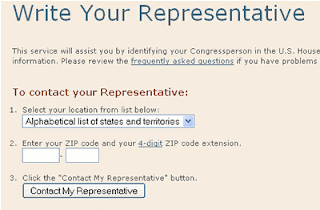
Now select the state or territory you live in, and enter your zip +4. (Don't know the last 4 digits of your zip code? Use the Postal Service's Zip+4 Lookup) Then click the "Contact My Representative" button. For this example, we used Gallaudet University's zip code.
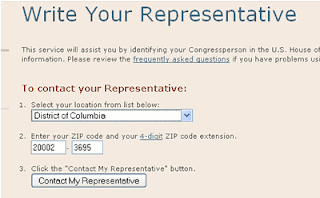
This takes you to a first form that you must fill out with your name, address, and city at a minimum. Then click "Continue to Text Entry Form." (It does not always work exactly the same for each representative. Caption Action 2 found that the system jumped directly to our own representative's website mail form.)
 The text entry form looks like this:
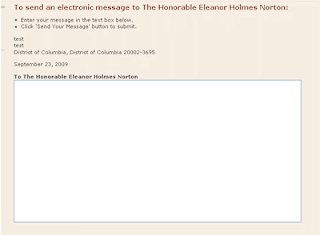
Enter your message, and click the "Send" button.
What can you enter? It is best to write straight from the heart so it does not look like a form letter, but some people prefer a form letter that they can partially customize. Below is a copy of a sample letter that was posted on the COAT website:
Ensure Equal Access to the New Technologies and Innovations of the 21st Century for People with Disabilities
Please Co-Sponsor H.R. 3101,
the Twenty-first Century Communications and Video Accessibility Act of 2009
[Today’s date]
Please Co-Sponsor H.R. 3101,
the Twenty-first Century Communications and Video Accessibility Act of 2009
[Today’s date]
Dear Representative [Last Name]:
I am a person with a disability and I want to be a part of the revolution in the way Americans interact, learn and conduct business using the new digital communications devices, television and the Internet. However, the wizardry of the wires and the sophistication of software programs often do little for those of us who need accessibility due to vision, hearing or other disabilities. Recently, the Twenty-first Century Communications and Video Accessibility Act of 2009 (H.R. 3101), was introduced. This legislation would ensure that all Americans have equal access to these exciting and innovative new technologies. It would enable me to [insert some personal details about how you would benefit].
H.R. 3101 would amend the Communications Act to ensure that new Internet-enabled telephone and video services and equipment are accessible to, and usable by, people with disabilities. From extending hearing aid compatibility and Internet closed captioning to real-time text support for emergency services, H.R. 3101 seeks to provide a smooth migration to the next-generation of Internet-based and digital communication technologies. For more information, see a one-page summary at http://www.coataccess.org/node/4624 and a section-by-section summary at http://www.coataccess.org/node/4623.
Please co-sponsor this bill so I can access and use phones and television like everyone else.
Sincerely,
[YOUR NAME]
[YOUR ADDRESS]
Friday, September 18, 2009
Milestone Reached: Caption Action 2 at 10,000!
At 12:50 pm today, the 10,000th person joined Caption Action 2 on Facebook. It took just under 3 months to reach this milestone! Caption Action 2 has sent an email to the 10,000th person asking permission to blog about him or her.
Also, we are getting asked about providing a template to send to Representatives. The problem with templates and form letters is that they do not speak from the heart. A template-based letter or form letter is more likely to be ignored by the Congressional office. You do not need a template or form letter to write about the fact you are deaf, and you want HR 3101 to pass because you need closed captions on the Internet.
In addition, if people share their letters, Caption Action 2 reprints the letters anonymously on the blog with the label "Letters." This gives people a feel for what kind of things they could say in their letters. Bottom line, it is best if you write straight from the heart, and say what YOU want to say, and not what a form letter or template tells you to say/do.
Tuesday, August 4, 2009
Independent Living Center Writes on HR3101
An interesting letter from the Independent Living Center in Southeast Missouri came to our attention. They are a disability services agency located in Poplar Bluff, Missouri, serving Butler, Carter, Ripley, and Wayne counties.
ILC letter concerning H.R. 3101
ILC letter concerning H.R. 3101
Monday, August 3, 2009
People Are Writing and Sharing Letters!
Michael Hill posted his letter to his representative, Phil Gingrey (GA) on Facebook, and gave permission to Caption Action 2 to reprint it here on the blog:
Dear Mr. Phil Gingrey,
I want to share with you a message on behalf of the deaf community. The message stated below:
"I am deaf and the 21st Century Communications & Video Accessibility Act of 2009 (H.R. 3101) is important to me, because it will enable me to understand the streaming videos if they are captioned. May I ask if you will be willing to cosponsor HR3101 - 21st Century Communications Act bill for the benefit of the deaf and hard of hearing citizens?
Thank you very much."
I'm not a Democrat nor a Republican. I'm just an American who believes in the Laws that protect ALL Americans of all ages, race, religion, and all forms of disabilities. I am a voter and I vote a person that can and will do the job to serve me and my community. I am 39 years old and I have been deaf since I was 3 years old. I am also blessed to have a 'voice' by speaking well as a hearing person(like you). I have been blessed to have closed captioning in my country to watch the local news, the national news(CNN, FOX, etc), and the sporting events since Closed Captioning first came out in 1979. It helped me understand the current events and share my discussions with my family and friends whether or not it was in good terms or bad terms.
If you take a moment to understand my point of view with the quoted message above, turn off your speakers on the computer and watch a video from CNN and/or your own introduction video. Is there something wrong there? There's no subtitles or closed captioning. How can I be able to watch videos on the Internet that does not have closed captioning(or subtitles) as much as watching TV that does have the feature inserted since the Law(A.D.A.) was passed back in the early '90s?
Talk to your fellow Congressmen/women, regardless of what Party they are in, and pass this on to the Senate and to the President's desk. I am sure President Obama will sign this Bill into Law to provide the services for all Deaf/Hard-of-Hearing Americans.
A Patriot,
Michael Hill
Comment from Caption Action 2: At Gingrey.House.gov, there is a welcome video with a talking head (the introduction video mentioned by Hill). What deaf person can understand that flapping mouth without captions?
Subscribe to:
Posts (Atom)